
How to fix your posture with strength training sounds simple enough, until you actually try it and realise stretching for ten minutes every morning is not doing much. Most people assume bad posture is a flexibility problem, so they stretch, foam roll, maybe try a posture brace for a week, and wonder why the hunch is still there by Friday. Our coaches see this constantly with clients who sit at a desk for nine, ten hours a day across Dubai. Here is what is actually going on, and what fixes it.
Short answer: how do you fix bad posture?
Fix posture by strengthening the weak side of the imbalance, not just stretching the tight side. That means 2 to 3 weekly sessions of pulling work (rows, face pulls), hip work (split squats, hip bridges), anti-extension core work and a programme built around your specific postural pattern not a generic stretching routine.
The 5 things that actually fix posture
1. Posture is a strength imbalance, not a flexibility issue
Tight muscles get all the blame, but tightness is usually just one half of the story. The other half is the muscles on the opposite side being too weak to pull your body back into position. You can stretch your chest all day, but if your upper back is not strong enough to hold your shoulders back, you will be right back in the same hunch an hour later. Fixing posture means strengthening the weak side, not just loosening the tight one.
2. Your current training is probably making it worse
This one surprises people. A programme built around bench press, push-ups and ab crunches strengthens the front of your body chest, shoulders, hip flexors while doing almost nothing for your back. Add a desk job on top of that and you have a body being pulled forward from every direction. Our coaches balance this out with rows, lat pulldowns and face pulls pulling movements that strengthen the mid-back and pull the shoulders back where they belong.
3. Tight hips are a sitting problem, not a stretching problem
Hours in a chair shortens your hip flexors and switches your glutes off, which tilts your pelvis forward and exaggerates the arch in your lower back. This is one of the most common things we see walking into our studios. Split squats and hip bridges done properly do more to fix this than any static stretch ever will, because they actually wake the glutes back up and teach your hips to sit in a better position under load.
4. Your core needs to resist movement, not just crunch through it
A strong core supports your spine, but endless sit-ups mostly just strengthen your ability to do sit-ups. What actually helps posture is anti-extension and rotation work like reverse crunches, dead bugs and controlled core holds that teach your spine to stay stable while the rest of your body moves. That stability is what keeps you upright through a long day, not just through a workout.
5. This needs an assessment, not a generic exercise list
Everyone's imbalance looks slightly different. Some people have rounded shoulders and a forward head. Others have an exaggerated arch in the lower back, and the fix for each is completely different. Our coaches start every new client with a proper postural assessment, then build the programme around your specific pattern not a one-size-fits-all sheet of "posture exercises" pulled off the internet.
Common postures and what actually fixes them
| Pattern | Usual cause | What actually fixes it |
|---|---|---|
| Rounded shoulders / forward head | Desk work, phone use, too much pressing | Rows, face pulls, band pull-aparts, neck-pack drills |
| Anterior pelvic tilt | Long hours sitting, weak glutes, tight hip flexors | Hip bridges, split squats, dead bugs, hip flexor mobility |
| Lower-back hyperextension | Weak deep core, dominant lower back | Reverse crunches, RKC planks, anti-extension work |
| Rounded upper back (kyphosis) | Mid-back weakness, thoracic stiffness | Pulldowns, prone Y-T-W raises, thoracic extensions |
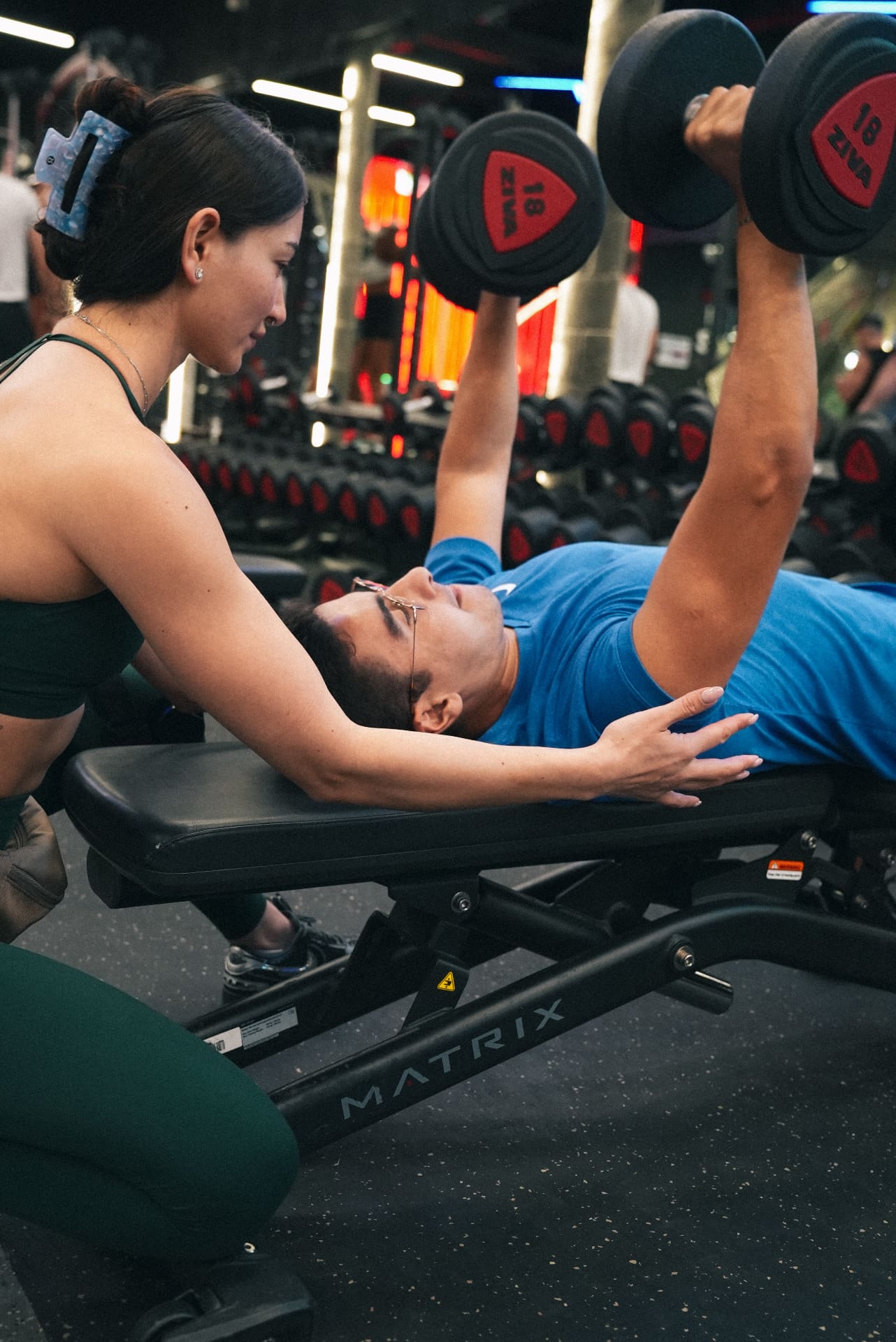
Image suggestion: Project Reshape coach cueing shoulder position on a client during a mid-back exercise. Alt text: "Personal trainer in Dubai coaching shoulder position during a posture-focused strength training session."
A simple weekly posture template
- Day 1 Pull focus: seated row, lat pulldown, face pulls, dead bug.
- Day 2 Hip focus: Bulgarian split squat, hip bridge, hip flexor stretch, side plank.
- Day 3 Posterior chain + core: Romanian deadlift, prone Y-T-W, reverse crunch, RKC plank.
Three sessions, 45 minutes each. Tracked progressive overload. Same lifts repeated for 6 to 12 weeks until they own them. That is the boring answer that actually works.
Posture is not held by stretching. It is held by strength in the muscles that have gone quiet from sitting and the only way back is to make them work under load.
The honest takeaway
Fixing posture is not about ten minutes of stretching squeezed in before bed. It is about building real strength in the muscles that have gone quiet, in a way that is actually programmed for your body not borrowed from a list. That is the difference between feeling looser for an hour and actually standing taller for good.
Frequently asked questions
Can strength training really fix bad posture?
Yes. Most bad posture is a strength imbalance, not a flexibility problem. Targeted pulling, hip and core work strengthens the muscles that have gone quiet from desk work and pulls your body back into alignment. Stretching alone rarely holds the change.
How long does it take to fix posture with strength training?
Most desk-based clients in Dubai see visible postural change in 6 to 12 weeks of consistent, well-programmed strength training 2 to 3 sessions per week. Lasting change requires fixing the underlying imbalance, not just doing stretches.
What are the best exercises to fix rounded shoulders?
Rows, lat pulldowns, face pulls and band pull-aparts. These pulling movements strengthen the mid-back and rear deltoids so your shoulders can sit back where they belong, instead of being pulled forward by an overworked chest and a desk job.
Do posture braces work?
Only short term. A brace holds you in position passively, but the underlying muscles stay weak and switch off further. Once the brace comes off, the hunch returns. Strength training builds the active support that holds posture without a device.
Should I get a posture assessment before training?
Yes. Rounded shoulders, forward head, anterior pelvic tilt and lower-back hyperextension all need different programmes. Our coaches in Dubai start every new client with a postural assessment so the work targets your specific pattern, not a generic checklist.
Book a postural assessment in Dubai
If years at a desk have caught up with your shoulders or your lower back, book a complimentary assessment with our coaches and let us find out exactly what is pulling you out of position no sales pressure, just an honest look at your movement and a plan forward.
- Book a complimentary postural assessment: project-reshape.com/contact
- WhatsApp our team for a faster reply during UAE hours.
- Related reading: personal training for DIFC desk-based executives, 5 strength training secrets from our female coaches, and our no-nonsense fitness guide for busy men in Dubai.