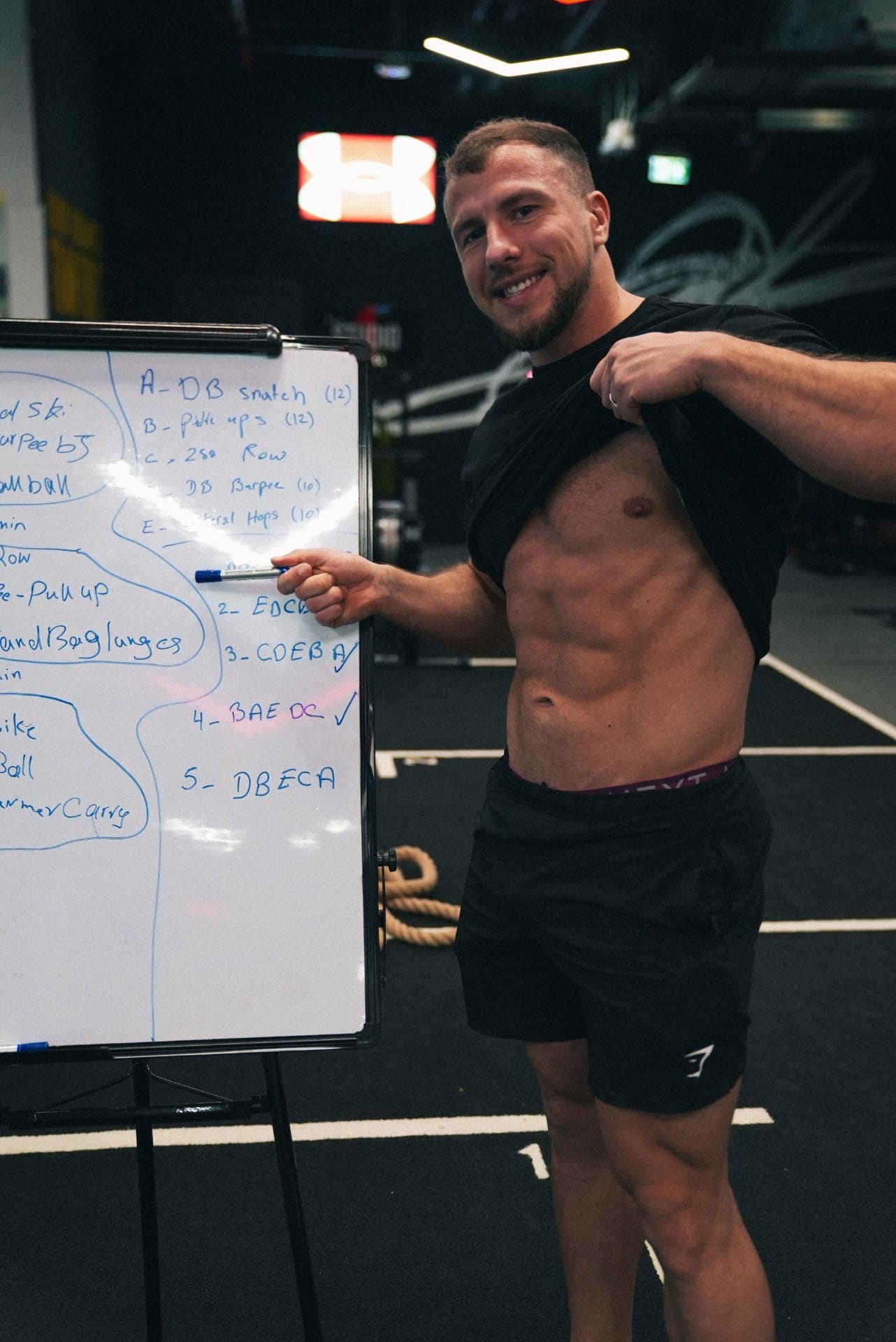

DIFC contains roughly twenty-five thousand of the most time-pressed people in the Gulf. The diary is unforgiving: 7am calls with London, 11am board work, 2pm client lunch at Zuma, 4pm Asia calls, 7pm dinner at La Cantine. Training is something most senior professionals here genuinely want to do and almost never quite manage. The result is the physique of a man who has been promising himself "next quarter" for nine years.
The training model that actually works for a DIFC executive looks nothing like the model a 28-year-old freelancer in Marina uses. It is shorter, denser, more conservative, and almost entirely engineered around the one thing the executive cannot manufacture more of: time. Here is what we run for our DIFC clients and why.
The three windows that actually exist in a DIFC week
- 06:30 - 07:45. The only sacred window most executives can defend.
- 12:30 - 13:30. Possible if your diary is well-managed and the studio is in the building.
- 18:30 - 19:30. Risky. Will collapse two weeks out of four to a client dinner or a slipped call.
A serious DIFC engagement runs on the morning slot two or three days a week, with one lunchtime backup window. Anything else is a calendar fantasy.
The 55-minute session and why an hour is too long
For a DIFC executive, the 60-minute session is the wrong unit. Sixty minutes plus shower plus walk back to the office plus settling at the desk is 90 minutes and 90 minutes does not survive a Tuesday. The unit we run is 55 minutes door-to-door, in a studio inside or directly adjacent to the Gate, with shower facilities. Walk in at 06:35, walk out at 07:30, at the desk by 07:45.
Programming for a brain that is already tired
A senior executive trains hard not for hypertrophy but for cognition, posture, sleep, joint health, blood pressure, body composition and confidence. The programme that delivers all of this looks remarkably simple:
- Three resistance sessions a week full body, heavy compound-led, low overall volume
- Two short conditioning pieces 12 minutes of intervals, not 45 minutes of cardio
- Daily steps target 8,000 minimum, hit on calls and in the building
- One mobility / decompression session on the weekend, 30 minutes
Notice what is not on the list: high-volume bodybuilding splits, six-day routines, fasted cardio, two-a-days. None of these survive an executive diary, none of them are necessary for the result, and most of them actively harm sleep and recovery in a population already running on a small deficit.
Nutrition that survives the DIFC lunch
Lunch at Zuma, Roberto's, La Petite Maison, Cipriani these are the office canteen for most DIFC executives. A serious nutrition strategy assumes two business lunches and one business dinner a week and works around them. The framework we use:
- Protein-led at every meal fish, beef, lamb, eggs as anchors
- Carbs around training and at the largest meal of the day, lower elsewhere
- Alcohol budgeted, not banned typically 4-6 drinks a week, around dinners
- Coffee capped at three cups a day, none after 14:00
- Late dinner is fine; the timing matters less than the composition
The recovery half nobody talks about
For a DIFC executive sleeping six hours a night and running on cortisol, the gym is the smaller half of the result. Sleep, alcohol management, sun exposure in the early morning, and one hard rest day a week are the larger half. A serious personal trainer in DIFC spends as much time on these as on the training itself, because the training fails without them.
The senior executive who finally gets in shape is almost never the one who found more time. He is the one who picked a model that fit the time he already had and a coach who built it around him, not around the gym.
How to choose a personal trainer in DIFC
- The studio must be inside or directly adjacent to the Gate every minute of commute is a minute the diary will eat
- The coach must be available before 07:00 anything else is theoretical
- Sessions must be 55 minutes door-to-door, not 60-minute "training time"
- The coach must have at least five other senior executive clients currently active this work is its own discipline
- There must be a contingency for the inevitable travel weeks a hotel-gym version of the programme, sent in advance
What it costs and what it returns
A serious DIFC personal training engagement in 2026 sits at AED 5,000-8,000 a month, usually three sessions a week with integrated nutrition. The result, twelve months in, is almost always: 8-12 kg of body fat lost, 4-6 kg of muscle gained, blood markers materially improved, sleep noticeably better, and almost universally a level of work capacity that the executive himself struggles to attribute to "just" the training.
For the people who actually run things from the Gate, training is not a wellness pursuit. It is operational maintenance on the asset that produces everything else.