If you lift weights and want to build muscle without adding unnecessary body fat, a practical protein target is usually around 1.6 g per kilogram of body weight per day, with many active people comfortably sitting within roughly 1.4 to 2.0 g/kg/day. Going higher can be useful in some situations, especially during a calorie deficit, but more protein is not automatically better. The biggest priorities are still progressive resistance training, enough total calories for the goal, and a protein intake you can consistently hit.
The useful question is not, what is the maximum protein I can eat? It is, what amount gives me enough amino acids to support training, recovery and lean mass while leaving room for carbohydrates, fats and foods I actually enjoy? That is the approach we use with clients at Project Reshape.
Protein and muscle: what it actually does
Resistance training gives your body the reason to adapt. Dietary protein supplies amino acids that are used to repair and remodel tissue after that training. Protein also supports enzymes, immune function and many other processes, so it should not be treated as a bodybuilding only nutrient.
A useful way to think about the relationship is simple: training is the signal, protein is part of the building material. If the training stimulus is weak or inconsistent, adding another shake does not compensate. In a large meta-analysis of resistance training studies, protein supplementation produced additional gains in fat free mass and strength, but the authors also emphasised that resistance training itself accounted for much more of the adaptation [1].
That distinction matters because people often reverse the order of importance. They obsess over protein timing while their programme has no clear progression, or they push protein so high that they under eat carbohydrates and train poorly. The goal is a complete system, not a single nutrient target.
The evidence based daily target for resistance training
For most healthy adults who strength train, a sensible starting range is approximately 1.4 to 2.0 g of protein per kilogram of body weight per day. The International Society of Sports Nutrition uses that range for exercising individuals [2]. A major meta-analysis found that gains in fat free mass tended to plateau around 1.62 g/kg/day on average, with uncertainty extending higher, and the authors noted that about 2.2 g/kg/day can be used as a pragmatic upper target for people who want to cover individual variation [1].
That does not mean every 85 kg client needs 187 grams. It means protein should be scaled to the person, their energy intake, training volume, appetite and preference. Someone eating at maintenance with a moderate training load may do very well near the middle of the range. A lean, resistance trained person dieting aggressively may prefer the higher end because protein can help preserve lean tissue and improve satiety.
For clients with kidney disease, significant medical conditions, pregnancy, or other circumstances that affect protein needs, the target should be agreed with an appropriate healthcare professional rather than copied from a gym calculator.
How much protein per meal, and how often?
Daily intake matters most, but distribution can make a good plan easier. ISSN guidance commonly cites about 0.25 g/kg of high quality protein per serving, or roughly 20 to 40 g for many adults, with meals spaced across the day [2]. Another practical approach is around 0.4 g/kg per meal across four meals if the daily target is approximately 1.6 g/kg.
There is no need to turn this into a stopwatch. A person who trains at 6:00 pm could have a protein containing breakfast, lunch, an afternoon meal or snack, and dinner after training. The advantage is not magic timing. It is that protein is available regularly and the daily target becomes easier to reach without one enormous late night meal.
For larger people, very active clients and those eating only two or three times per day, individual meals may need to be larger. The plan should fit the schedule rather than forcing the schedule to fit a theoretical perfect feeding pattern.
The post workout window is wider than social media makes it sound
You do not lose your workout because you failed to drink whey within 30 minutes. Resistance exercise increases the muscle sensitivity to protein for many hours. A meal containing quality protein within a reasonable period around training is useful, but the total day matters far more than chasing a tiny window.
If you trained after a protein rich meal, there is less urgency. If you trained fasted or have not eaten for several hours, eating after the session becomes more important. This is why context beats rules. The same person can need different timing on a 7:00 am session compared with a 7:00 pm session. Our guide to what to eat before and after a workout covers that in more detail.
Protein while dieting: protecting lean mass during fat loss
When calories fall, the job of protein becomes more important because the body is receiving less total energy. The main objective is to lose fat while keeping as much muscle and training performance as possible. Adequate protein, resistance training and a sensible calorie deficit work together toward that goal.
The leaner and more highly trained someone is, the more cautious the deficit should usually be. Very aggressive dieting can make training quality, sleep, mood and adherence worse. Simply adding more protein does not eliminate those problems. We would rather keep a client training well on a controlled deficit than boast about a very high protein number while performance collapses.
Protein is also useful because higher protein meals can be filling. That matters in Dubai, where business lunches, brunches and restaurant meals can make calorie intake hard to estimate. A consistent protein anchor at each meal creates structure without requiring a rigid clean eating menu. If the scale and the mirror disagree, our article on losing weight versus losing fat explains why.
Whole foods versus whey: when supplements are useful
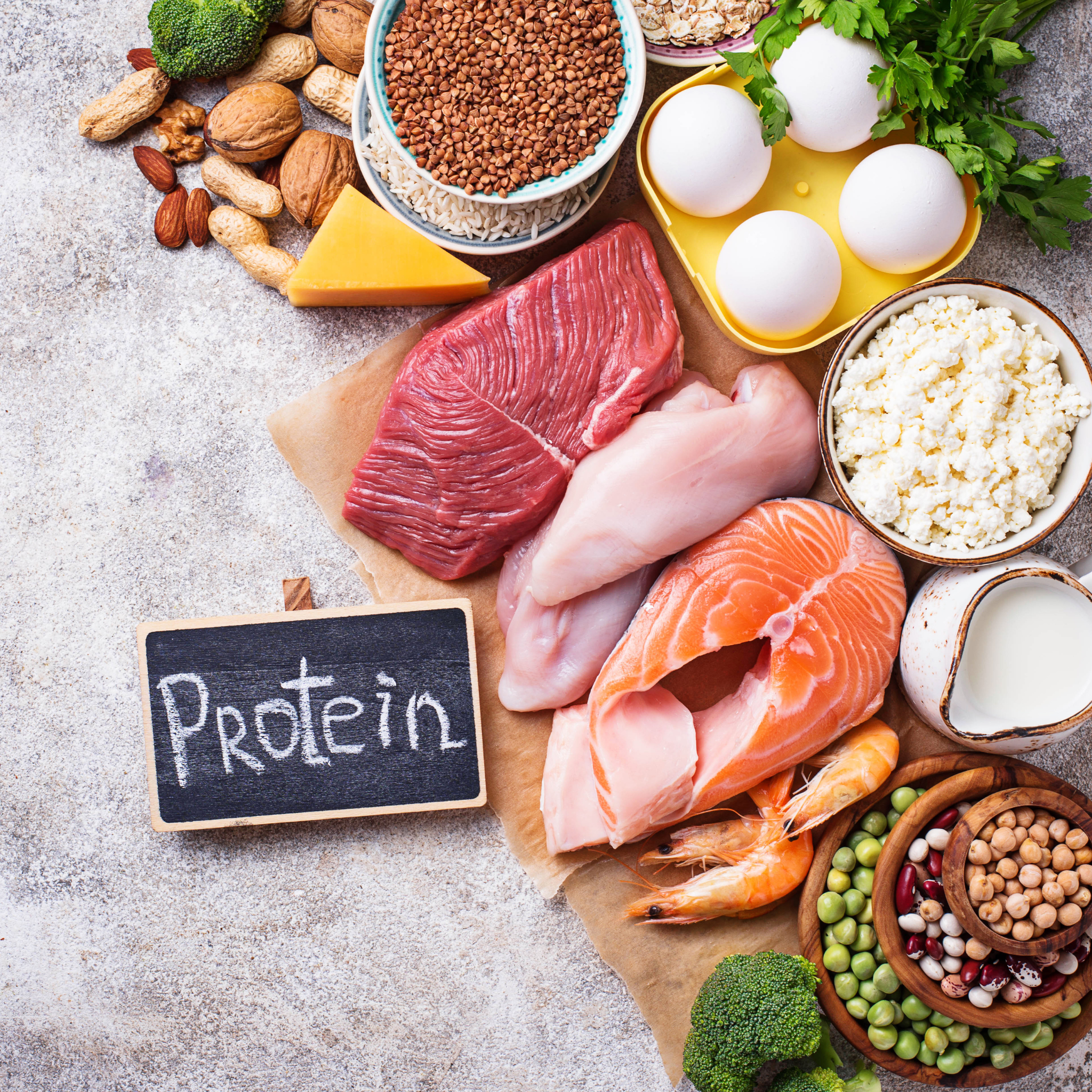
Whey protein is convenient, not mandatory. Whole foods bring protein together with micronutrients, fibre or other useful nutrients depending on the food. Chicken, fish, eggs, Greek style yogurt, lean meat, milk, cottage cheese, lentils, beans, tofu and other options can all contribute.
A protein powder becomes useful when convenience is the limiting factor: an early client meeting, a short gap between work and training, travel, or simply an appetite that makes a full meal difficult. One scoop that helps you hit the plan is more valuable than a supplement cupboard full of products that do not solve a real problem.
Plant based diets can also support muscle gain. The main considerations are total protein, food variety, protein quality and sometimes slightly larger portions or blended sources to achieve enough essential amino acids.
Three practical examples by body weight
These examples are not prescriptions. They show how a target can translate into ordinary meals. Actual calories and food choices should be adjusted to the person.
- 70 kg client: a daily target around 110 to 125 g could be split into four feedings of roughly 25 to 35 g. Breakfast might be eggs plus Greek style yogurt, lunch chicken with rice and salad, an afternoon yogurt or shake, dinner fish, potatoes and vegetables.
- 85 kg client: a target around 135 to 155 g could be reached with a 35 g breakfast, 40 g lunch, 30 g snack and 40 to 45 g dinner. In Dubai, that could still include restaurant meals: grilled meat or fish, rice or potatoes, salad, and a deliberate portion rather than trying to eat perfectly.
- 100 kg client: a target around 160 to 180 g may be reasonable depending on goals and body composition. Four meals of roughly 40 to 45 g make the number more manageable. If appetite is high, use mostly whole foods. If the schedule is tight, one shake can reduce friction.
What we do with clients at Project Reshape
We do not hand everyone the same grams per kilogram number. During assessment and weekly check ins, protein is set alongside calorie needs, training load, food preferences, work schedule, travel and body composition goals. If weight, performance, hunger or recovery changes, the nutrition target changes too. That is the same principle behind how training and nutrition work together.
The aim is a target you can execute in real life. That usually beats a theoretically perfect number that survives for four days.
Frequently asked questions
Is 2 g of protein per kilogram too much?
For most healthy, exercising adults, intake around this level falls within commonly used sports nutrition ranges. It is not automatically necessary, though. People with kidney disease or other relevant medical conditions should get personalised medical nutrition advice.
Can I build muscle with less than 1.6 g/kg?
Yes. The 1.6 g/kg figure is an average point around which additional benefit appeared to level off in one large meta-analysis, not a minimum threshold below which muscle growth becomes impossible. Training quality, calories and your baseline diet still matter.
Do I need protein immediately after training?
No strict 30 minute deadline exists. A protein rich meal within a reasonable window is useful, especially if you trained without eating beforehand, but daily intake is the bigger priority.
Is whey better than food?
Not inherently. Whey is convenient and high quality. Whole foods can provide the same protein target while also supplying other nutrients. Use whey when convenience helps the plan.
Does more protein make fat loss faster?
Protein can improve fullness and help preserve lean mass during dieting, but fat loss still depends on maintaining an energy deficit over time.
Conclusion
Protein matters, but precision should not become obsession. For most people who lift, a well distributed daily intake around the evidence based range, paired with progressive training and an appropriate calorie intake, is enough. Start with the number you can consistently hit, judge it alongside performance, hunger and body composition trends, and adjust from real data.
Next step
- Book your free assessment: request a consultation and we will turn this general range into targets matched to your body composition, training load and lifestyle.
- Related reading: training and nutrition together, what to eat before and after a workout, losing weight versus losing fat.
Sources
- [1] Morton RW, et al. A systematic review, meta-analysis and meta-regression of protein supplementation and resistance training adaptations. Br J Sports Med. 2018;52:376-384.
- [2] Jager R, et al. International Society of Sports Nutrition Position Stand: protein and exercise. J Int Soc Sports Nutr. 2017;14:20.
- [3] Cleveland Clinic. How Much Protein Do You Need Daily?